Skip to content

WhatsApp Funnel

Fix Your WhatsApp Conversion System

WhatsApp Commerce

WhatsApp Customer Journey Design: From First Chat to Repeat Order

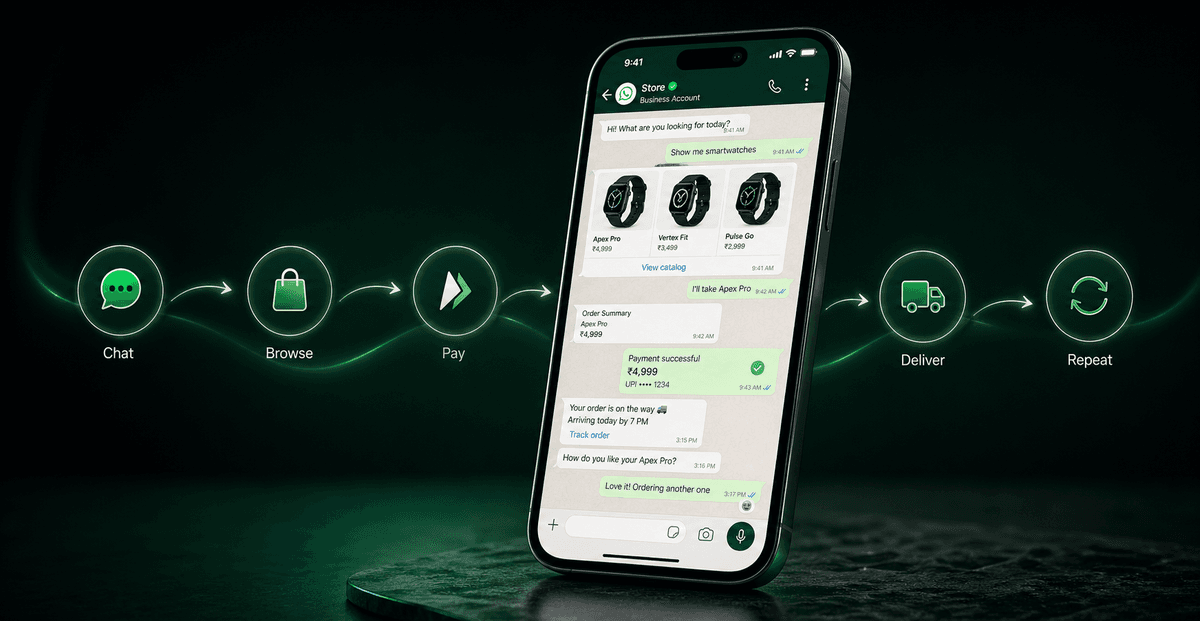
OG Marka WhatsApp commerce cover image for customer journey design article

Quick Answer

WhatsApp customer journey design turns disconnected chats into one operating system. It maps how a customer enters from ads or the website, gets qualified, receives buying guidance, completes payment, receives support, and comes back to reorder with clear routing, timing, and ownership at every step.

By the Numbers

Research signals worth checking before you commit budget

Treat these as planning inputs, not guaranteed outcomes. Validate them against your own funnel, service mix, and margins.

5 journey stages

Maps entry, qualification, conversion, post-purchase support, and retention into one operating model.

Source: OG Marka editorial framework

30-day rollout plan

Sequences journey mapping, automation, handoffs, and KPI reviews into four weekly build cycles.

Source: OG Marka implementation playbook

3 core handoff audits

Teams should review sales-to-support, support-to-retention, and agent-to-manager escalations every week.

Source: OG Marka operating checklist

Sources & Methodology

Use these links to verify the market claims in this guide

Preference is given to official surveys, primary reports, and vendor methodology pages over unsourced roundup statistics.

Primary source

What is a customer journey map? The complete overview [examples + templates]

Open source
Primary source

What Is Conversational Commerce? Definition and Guide - Shopify

Open source
Primary source

14 Customer Retention Strategies That Help Increase ROI - Shopify

Open source

WhatsApp Customer Journey Design: From First Chat to Repeat Order

WhatsApp customer journey design turns disconnected chats into one operating system. It maps how a customer enters from ads or the website, gets qualified, receives buying guidance, completes payment, receives support, and comes back to reorder with clear routing, timing, and ownership at every step.

WhatsApp customer journey design helps Indian brands turn chat from a reactive inbox into a revenue system. This tutorial shows founders, operators, and growth teams how to connect entry source, qualification, conversion, support, and repeat purchase so customers do not get lost between teams.

The problem is rarely message volume alone. The real problem is that most businesses run ads, payment follow-up, support updates, and retention campaigns as separate motions. Customers feel the gaps immediately: they repeat context, wait for the wrong team, or disappear after a stalled payment because nobody owns the next step. For a broader platform baseline, see our complete guide to WhatsApp Business automation.

What is WhatsApp customer journey design?
WhatsApp customer journey design is the practice of mapping how a lead enters chat, gets qualified, moves to payment, receives support, and returns to buy again without losing context between teams, tools, or owners.
WhatsApp customer journey map showing entry, qualification, conversion, post-purchase, and retention stages
Journey design works when acquisition, sales, support, and retention all work from the same customer context.

What breaks most WhatsApp journeys?

A weak journey looks busy from the outside and expensive from the inside. Leads enter from click-to-chat ads or the website, but the first response does not carry source context. Product questions, COD clarifications, delivery issues, and repeat-order requests land in one queue. A payment link gets sent, but recovery is nobody's job. Post-purchase support resolves the issue, then the customer disappears because retention never sees that conversation.

In our experience, this is where teams misdiagnose the problem. They assume they need more agents or more campaigns. The better audit is simpler: where does context break, where does ownership break, and where does the next step become optional? That audit usually reveals the real leakage much faster than another dashboard filter.

  • Entry source is missing, so every conversation starts with guesswork.
  • Qualification questions are inconsistent across shifts or agents.
  • Payment follow-up depends on memory instead of a rule.
  • Support history never informs retention or reorder timing.
  • Managers only see reply volume, not movement across stages.

The 5-stage WhatsApp customer journey design framework

This framework is the core operating model we recommend when chat is expected to influence revenue, support quality, and retention at the same time. It is simple enough to implement in one month, but detailed enough to run as an ongoing optimization program.

Stage 1: Entry

Every conversation needs source and intent before the first human decision. A customer from a reorder reminder should not receive the same opening as a first-time product inquiry. Entry design should capture source, campaign, message context, and the most likely intent path before the team starts asking follow-up questions.

Stage 2: Qualification

Qualification answers three things quickly: who the customer is, what outcome they want, and who should own the next step. This is where structured prompts or flows are useful because they reduce repetition and keep the same data visible to the next owner. Qualification is also where service businesses can separate booking, diagnostics, support, and billing paths before the queue becomes noisy.

Stage 3: Conversion

Conversion is not only the payment moment. It includes product guidance, price clarity, offer fit, objection handling, checkout support, and recovery when the customer stalls. Good conversion design shortens the number of decisions between interest and payment while preserving a fast escape path to a human for high-intent buyers.

Stage 4: Post-purchase

Post-purchase should do more than send confirmations. It should carry delivery updates, onboarding, issue resolution, escalation rules, and early signals for future upsell or churn risk. Support is one of the strongest parts of the journey because it reveals whether the promise made during conversion was actually delivered.

Stage 5: Retention

Retention is where the economics improve. Reorder reminders, replenishment windows, loyalty nudges, service follow-ups, and rebooking prompts should feel like a continuation of the same journey rather than a new campaign. That is the difference between chat as a channel and chat as an operating system.

Which moments should be automated and which should stay human?

Automation should remove repetitive friction, not hide commercial or emotional judgment. The best rule is to automate structured, high-frequency steps and reserve humans for moments where confidence, negotiation, or empathy affect the outcome.

WhatsApp Business Platform is built for business messaging at scale, which makes it useful for routing, notifications, and system-driven follow-up. WhatsApp Flows documentation is especially relevant when qualification or booking requires structured inputs inside chat rather than open-ended back-and-forth. For measurement ideas after launch, use our WhatsApp analytics dashboard guide.

Automate acknowledgement, routine qualification, payment reminders, order updates, and reorder windows. Keep a human in the loop for high-value buyers, unusual objections, escalations, refund disputes, medical or financial edge cases, or any moment where the wrong answer will damage trust more than speed helps it.

Step-by-step build plan for the first 30 days

  1. Step 1. Map your top three entry sources and label each by business value, urgency, and expected intent.
  2. Step 2. Define the qualification questions that every owner needs before they can responsibly take the next action.
  3. Step 3. Create routing rules for payment support, product guidance, delivery issues, and repeat-purchase requests so the queue stops behaving like one generic inbox.
  4. Step 4. Build one conversion recovery path for stalled payment and one post-purchase path for delivery or onboarding updates.
  5. Step 5. Connect support outcomes to retention triggers so solved issues, reorder windows, and repeat-intent signals feed the next campaign or reminder.
  6. Step 6. Review the full journey weekly, then fix the biggest drop-off, repeated handoff failure, or missed follow-up first.

This step-by-step block is the practical roadmap. It is also the minimum checklist teams need before they start layering on AI agents, CRM automation, or paid acquisition scale. If the basic ownership map is broken, more tooling only hides the breakage.

Journey ownership map and KPIs

Every stage should have one accountable owner, one backup owner, and one primary KPI. Without that structure, the journey becomes a shared aspiration instead of a managed system.

StagePrimary ownerMain KPIFailure signal
EntryGrowth or acquisition teamQualified chat start rateHigh click volume but low qualified conversations
QualificationSales ops or intake ownerQualification completion rateCustomers repeat answers or wait for reassignment
ConversionSales ownerPayment completion rateRepeated abandoned payment links
Post-purchaseSupport leadResolution time and repeat-contact rateCustomers reopen the same issue
RetentionCRM or lifecycle ownerRepeat order or rebooking rateCustomers vanish after support closes

Platform-aware rules worth using in the design

WhatsApp Flows gives teams a way to collect structured details inside chat, which is useful for qualification, booking, and support pre-checks. That matters because the journey is stronger when the customer can complete one clear task without being pushed across multiple forms, tabs, and follow-up requests.

We recommend using flows and structured inputs where the business needs consistency, then handing control to a human when the conversation becomes commercial, sensitive, or unusual. That blend keeps response speed high without flattening every customer into the same script.

Two implementation playbooks teams can copy

D2C example: A skincare brand runs click-to-chat campaigns for different product concerns. Entry tags the campaign, qualification asks about skin concern and budget, conversion sends a curated bundle, post-purchase handles delivery and usage questions, and retention sends a replenishment reminder at the expected reorder window. For example, a delayed COD confirmation should not restart as a generic support case; it should continue from the original buying intent.

Service business example: A clinic receives inquiries from search, referrals, and existing patients. Qualification separates first consultation, follow-up, and support. Booking moves quickly to a human scheduler. Post-visit reminders and test updates stay automated, while retention focuses on rebooking windows and care-plan continuity. The playbook is the same; only the decision points change.

Where should teams audit the journey every week?

Weekly review is where WhatsApp customer journey design becomes a management habit instead of a one-time workshop. The review should be short, evidence-based, and tied to the stage with the highest commercial leakage.

  • Check which entry sources create the best-qualified chats, not just the most chats.
  • Review where customers stall between qualification and payment.
  • Audit handoffs from sales to support and support to retention.
  • Look for repeated questions that should become a structured prompt or flow.
  • Track which repeat-purchase prompts actually create revenue, not only replies.

If you want one implementation rule to keep, make it this: every unresolved break must be assigned to a stage owner before the week ends. That is how the framework becomes an operating system instead of a document.

Get WhatsApp Funnel Strategy

If your team is already generating conversations but the system still leaks between first chat, payment, support, and repeat order, the next move is WhatsApp customer journey design, not more disconnected campaigns. Request a WhatsApp funnel strategy session.

Frequently Asked Questions

Share this article

Get insights delivered weekly

Continue Reading

WhatsApp Commerce for D2C Brands: Catalog, Checkout, and Repeat Purchase Systems

6 min read
Featured: WhatsApp Repeat Purchases for D2C Brands: 2026 Retention Playbook

WhatsApp Repeat Purchases for D2C Brands: 2026 Retention Playbook

6 min read
Featured: WhatsApp Analytics Dashboard for Revenue Teams: What to Track Beyond Replies

WhatsApp Analytics Dashboard for Revenue Teams: What to Track Beyond Replies

6 min read

Join 1,000+ business builders

Get weekly insights on AI, CRM, WhatsApp Commerce, and growing your business. No spam, unsubscribe anytime.

No spam. Unsubscribe anytime. We respect your inbox.