Skip to content
Digital Growth

Digital Transformation Playbook for Indian SMBs in 2026

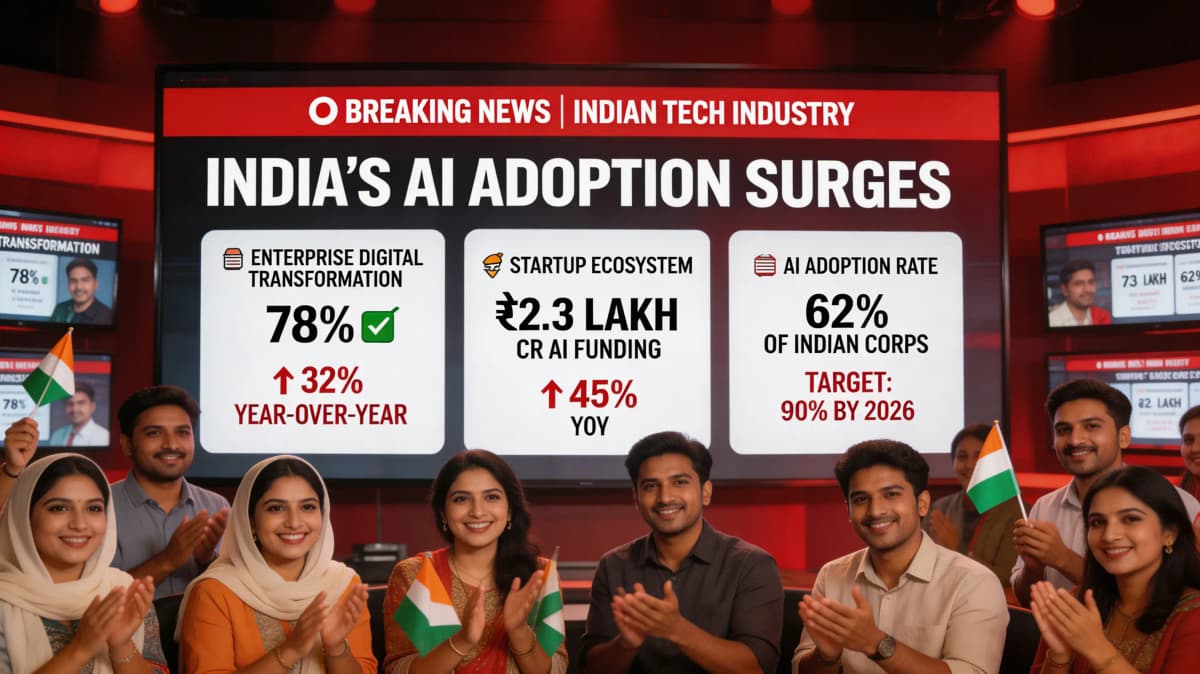
Featured image for Digital Transformation Playbook for Indian SMBs in 2026

Quick Answer

Digital transformation in 5 phases: website (Wk1-2), CRM (Wk3-4), WhatsApp (Wk5-6), AI (Wk7-8), SEO (Wk9-12).

What is digital transformation Indian SMBs 2026?
digital transformation Indian SMBs 2026 encompasses the strategies and tools that help Indian businesses drive growth, improve efficiency, and gain competitive advantage in 2026.
Digital Transformation Playbook for Indian SMBs in 2026 - Visual Guide for Indian Businesses
Digital Transformation Playbook for Indian SMBs in 2026

Digital Transformation Playbook for Indian SMBs in 2026

Digital transformation has stopped being a strategic buzzword and become an operational necessity. Indian SMBs that once questioned whether digital investment was essential now urgently ask: how do we catch up? The urgency is justified. Companies delaying digital transformation are losing market share to digitally-enabled competitors. As India's digital transformation market accelerates from USD 124.42B in 2025 to USD 267.01B by 2030 (16.5% CAGR), the performance gap between digital leaders and digital laggards will only widen.

Yet "digital transformation" remains nebulous for many SMB leaders. The concept encompasses everything from cloud migration to AI implementation to supply chain automation. Where should SMBs start? What's the logical sequence? How much should transformation cost? What timeline is realistic? This playbook provides a practical roadmap for Indian SMBs planning digital transformation in 2026—grounded in real-world implementation experience rather than consultant buzzwords.

Phase 1: Foundation—Establishing Core Digital Infrastructure (Months 1-3)

Successful digital transformation starts with unglamorous fundamentals: establishing reliable data and operational infrastructure. Many SMBs lack basic digital hygiene—accurate financial records, integrated business systems, documented processes, clean data. Digital transformation built on this foundation fails repeatedly.

Core ERP Implementation: Deploy cloud ERP as foundational infrastructure. This consolidates fragmented systems (separate invoicing software, spreadsheet accounting, email-based order management) into unified source of truth. Implementation focuses on establishing accurate financial records, consistent process workflows, and reliable data. Typical timeline: 4-6 weeks. Cost: Rs 3-8 lakhs depending on business complexity.

Critical success factors: executive sponsorship, clear process documentation, disciplined data cleanup, and team training before go-live. Many SMB transformations fail at this stage due to inadequate planning or underestimating change management effort. Successful implementations dedicate 20-30% of the CFO's time to ERP deployment.

Data Cleaning and Consolidation: Use ERP implementation to clean and consolidate historical data. Reconcile accounts, eliminate duplicate customer/vendor records, standardize product codes, and establish accurate inventory counts. This unglamorous work determines everything downstream. An ERP system built on poor data foundations creates misleading reports, flawed analytics, and poor decision-making.

Cloud Infrastructure Establishment: Migrate basic business systems to cloud: email (if not already), document management, collaboration tools, basic accounting. This establishes cloud-first culture and demonstrates reliability and security of cloud systems to skeptical teams.

Phase 2: Visibility—Real-Time Business Intelligence (Months 3-6)

With reliable operational data in place, focus on visibility: providing managers at every level with real-time insights into business performance. Most SMBs operate on monthly or quarterly financial reports—information that's months outdated by the time decisions are made. Real-time dashboards change this fundamentally.

Dashboard and Reporting Implementation: Build executive dashboards showing: revenue trends, profitability by product/customer/region, cash flow status, operational KPIs (inventory turnover, customer acquisition cost, production efficiency). These dashboards update in real-time as operational data flows into ERP. Cost: Rs 2-5 lakhs. Timeline: 2-3 weeks after ERP stabilization.

Dashboard value is transformative for SMB management. A manufacturing CFO can instantly see margin erosion in specific product lines and trigger cost analysis within hours instead of waiting for monthly reports. A sales manager can identify underperforming representatives and provide targeted coaching based on real-time pipeline data. Operations managers can spot production bottlenecks and schedule maintenance proactively rather than reactively.

Mobile Enablement: Provide mobile applications enabling teams to access critical information from anywhere. Sales teams can check inventory availability while with customers. Operations managers can review production metrics from the shop floor. Finance can review cash position from board meetings. This mobility increases decision-making speed significantly.

Phase 3: Automation—Eliminating Manual Processes (Months 6-9)

With visibility in place, focus on automation: identifying high-volume manual processes and automating them. Digital India programs emphasizing "Make in India" and process efficiency have demonstrated that 40-60% of typical SMB administrative work can be automated. This frees staff for higher-value work and reduces error rates dramatically.

Financial Process Automation: Automate accounts payable (invoice matching to purchase orders, approval workflows, payment processing), accounts receivable (invoice generation, payment reminders, reconciliation), and general ledger (consolidation, journal posting, variance analysis). Typical time savings: 50-70% of finance team's transactional work. Cost: Rs 2-4 lakhs. Timeline: 2-3 months depending on process complexity.

Supply Chain Automation: Automate procurement (purchase order generation based on inventory triggers, supplier communication, receipt matching), inventory management (stock level optimization, reorder point calculation, obsolescence alerts), and logistics coordination. For manufacturers and distributors, supply chain automation delivers 15-25% working capital improvement and 20-30% reduction in procurement lead times.

Sales and Marketing Automation: Implement lead scoring, automated follow-up workflows, email campaigns triggered by customer behavior, and sales pipeline analytics. E-commerce businesses particularly benefit: abandoned cart recovery, dynamic pricing based on demand signals, and personalized product recommendations. Typical ROI: 15-20% improvement in conversion rates.

Phase 4: Integration—Connecting Systems and Data (Months 9-12)

As multiple systems are deployed and automated, focus on integration: ensuring data flows seamlessly across systems without manual intervention. An e-commerce system should automatically update inventory in ERP. Marketing automation should feed qualified leads into CRM. CRM should trigger ERP order workflows. Integration eliminates the disconnects that plague traditional systems.

API-Based System Integration: Use cloud-native APIs and middleware platforms (Zapier, Make, Boomi) to connect disparate systems. Rather than expensive custom middleware, modern integration platforms enable rapid API-based connections. An SMB can typically integrate 8-12 key business systems in 2-3 months at cost of Rs 3-5 lakhs.

Supply Chain Visibility: Extend visibility beyond company boundaries. Integrate with supplier systems (purchase order tracking, shipment visibility, quality data). Integrate with logistics providers (shipping status, delivery confirmation). Integrate with customer systems (order acknowledgment, shipment notification). This end-to-end visibility enables proactive supply chain management rather than reactive crisis management.

Phase 5: Intelligence—AI and Predictive Analytics (Months 12-18)

With reliable data, visibility, and integrated systems in place, deploy advanced analytics and AI-driven insights. This is where transformation compounds—systems don't just report what happened, they predict what will happen and recommend actions to optimize outcomes.

Demand Forecasting: Deploy machine learning models analyzing historical sales, seasonal patterns, promotional impact, and market trends to predict future demand. Indian manufacturers implementing demand forecasting report 15-25% improvement in forecast accuracy and 10-20% reduction in excess inventory. E-commerce businesses achieve 8-12% improvement in stock-out rates.

Predictive Maintenance: For manufacturers, deploy IoT sensors and ML models predicting equipment failures before they occur. This shifts maintenance from reactive (respond to breakdowns, incurring production downtime) to proactive (perform maintenance before failures occur). For high-value equipment, this improvement prevents production losses and extends asset life—typical ROI: 20-25% reduction in unplanned downtime.

Customer Intelligence: Deploy analytics identifying high-value customers, predicting churn risk, and recommending retention actions. These insights drive 10-15% improvement in customer lifetime value through targeted retention investments and 5-10% improvement in sales by focusing efforts on highest-potential prospects.

Phase 6: Optimization—Continuous Improvement (Months 18+)

Transformation isn't a destination—it's ongoing optimization. With systems in place and data flowing, focus becomes continuous improvement: identifying bottlenecks, testing process variations, and implementing incremental improvements that compound over time.

Process Mining: Deploy process mining tools analyzing actual process execution (not documented processes, but how work actually gets done). These tools identify bottlenecks, redundant steps, and opportunities for streamlining. A finance department may document 5 steps for invoice processing, but process mining might reveal 12 actual steps due to workarounds and exception handling. This insight drives targeted process redesign.

Continuous Experimentation: Establish small teams experimenting with process variations: testing different pricing strategies, supply chain configurations, marketing approaches. Successful experiments scale broadly. Failed experiments provide learning at minimal cost.

Critical Success Factors for Indian SMB Transformation

Executive Alignment: Digital transformation requires sustained commitment from CEO/founder through implementation. Transformations that falter typically do so due to competing priorities pulling executive focus. Successful transformations establish transformation as top-3 priority with dedicated executive owner.

Change Management: Technology is the easy part—change management is hard. Employees comfortable with existing processes resist new systems, especially when transformation increases accountability and transparency. Successful transformations invest heavily in training, communication, and recognizing early adopters.

Realistic Timeline and Budget: Transformation typically requires 12-18 months and Rs 15-30 lakhs for mid-market SMBs. Attempts to accelerate timelines create quality issues. Attempts to minimize costs lead to inadequate training and poor adoption. Most transformation failures result from unrealistic expectations rather than technology limitations.

Clear Metrics and Accountability: Define success metrics at transformation outset. Revenue growth targets? Profit margin improvement? Working capital reduction? Operational efficiency gains? Transformation must drive measurable business improvement—not be an IT project for its own sake.

Several India-specific trends are shaping SMB transformation strategies:

Smart Manufacturing Adoption: Manufacturers are moving from optional to essential smart manufacturing capabilities—IIoT sensors, predictive analytics, hybrid cloud architectures, and cybersecurity convergence. SMBs that haven't implemented basic digitalization by 2026 will struggle competing with digitally-enabled peers.

Supply Chain Resilience: Supply chain disruptions in recent years have accelerated automation adoption. SMBs recognizing that visibility and automation are essential to supply chain resilience are prioritizing these investments.

Talent-Driven Transformation: Indian companies recognize that 80% of employers report difficulty finding skilled professionals. Digital transformation addresses this by automating routine work and enabling smaller teams to accomplish more. SMBs competing for talent are using digital-first operations as a talent attraction tool.

Cloud-Native Architecture: Rather than migrating on-premise systems to cloud, successful SMBs are adopting cloud-native, modern architecture—using SaaS platforms, APIs, and microservices rather than monolithic systems. This approach is more scalable, more agile, and better suited to SMB evolution.

Key Takeaways: Digital Transformation as Competitive Imperative

Digital transformation is no longer optional for Indian SMBs. The companies thriving in 2026 will be those that recognized transformation as imperative, established clear roadmaps, and executed disciplined implementation. The companies struggling will be those that delayed transformation hoping to maintain status quo—and now face urgent pressure to catch up while managing business disruption.

This playbook provides the roadmap. Execution—assembling the team, maintaining commitment, managing change, and iterating based on results—is where transformation succeeds or fails. SMB leaders who treat transformation as top-3 priority and execute this playbook systematically will emerge as industry leaders in 2026 and beyond.

Quick Comparison

MetricTraditional ApproachWith digital transformation Indian SMBs 2026
EfficiencyManual processes, slow executionAutomated, 3-5x faster results
Cost ImpactHigh operational overhead25-40% cost reduction
ScalabilityLimited by headcountScales without linear cost increase
Decision MakingGut-feel basedReal-time data-driven insights

Implementation Steps

Step 1: Assess Your Current State

Audit existing processes to identify where digital transformation Indian SMBs 2026 can deliver the highest ROI for your Indian business.

Step 2: Choose the Right Solution

Evaluate solutions based on India-specific needs: UPI integration, multilingual support, GST compliance, and WhatsApp connectivity.

Step 3: Pilot and Scale

Launch a 30-60 day pilot with one team or workflow, measure KPIs, then scale across the organisation.

Frequently Asked Questions

Share this article

Continue Reading

Featured: Quick Commerce Meets D2C: How Brands Win in India's Fastest Channel

Quick Commerce Meets D2C: How Brands Win in India's Fastest Channel

11 min read
Featured: The Rise of Conversational Commerce in India: 2026 Trends Report

The Rise of Conversational Commerce in India: 2026 Trends Report

9 min read
Featured: Performance Marketing Trends for D2C Brands in 2026

Performance Marketing Trends for D2C Brands in 2026

9 min read