
ChatGPT ads integration is now a workflow decision, not a distant media trend. OpenAI added CPC bidding and a beta Ads Manager on May 5, 2026. Adobe also said GenStudio customers can assemble and activate ads into ChatGPT directly. Brand teams should now set simple rules for assets, claims, and measurement before budgets grow.
ChatGPT ads integration matters because two different layers of the market moved on the same day. OpenAI expanded how advertisers can buy ChatGPT ads. Adobe added a governed production path for ChatGPT ad activation inside GenStudio.
This guide helps Indian brand and growth teams decide what to build first. Treat conversational ads as a real acquisition workflow. Do not bring search-era habits into a conversational channel.
What changed in ChatGPT ads integration on May 5?
OpenAI said advertisers can now buy ChatGPT ads through partners or a new beta self-serve Ads Manager. It also introduced CPC bidding and broader measurement tools.
That matters because the buying model now looks more operational and less experimental. The product is still a pilot, but the direction is clearer. OpenAI also said the ads pilot will expand to additional markets including Brazil, Japan, Mexico, South Korea, and the United Kingdom in the weeks after its May 7 update.
Adobe moved from the workflow side. It said GenStudio for Performance Marketing now enables direct ad assembly and activation into ChatGPT.
The useful part is not only the integration. It is the control model underneath it. Teams can choose approved assets, work from templates, run review in Workfront, and then activate without breaking brand rules.
- ChatGPT ads integration (Definition)
- ChatGPT ads integration is the workflow a team uses to plan, approve, launch, and measure paid placements in ChatGPT. The value is not only reach. It is the ability to manage conversational creative with the same control used in other paid channels.
The scale signal matters too. OpenAI recently said its voice infrastructure supports more than 900 million weekly active users.
That number is not specific to the ads product, but it helps explain why software and media teams now treat conversational AI as a normal discovery surface.
Why does ChatGPT ads integration matter for Indian growth teams?
Conversational interfaces are not just another placement. Search and social ads often start with weak intent signals.
A user types a short query or scrolls past a post. In ChatGPT, the user often arrives with goals, budget, context, and comparison criteria in one prompt. That changes the job from interruption to useful response support.
| Channel pattern | User signal quality | Operational risk | What teams should change |
|---|---|---|---|
| Classic search ads | Short, keyword-led intent | Broad-match waste and weak landing-page fit | Tighten query mapping and landing-page depth |
| Social feed ads | Interruption and inferred interest | Creative fatigue and broad targeting noise | Refresh hooks and audience segmentation faster |
| Conversational ads in ChatGPT | Long-form, explicit intent with constraints | Brand drift if prompts and assets are unmanaged | Build governed creative systems and intent-specific variants |
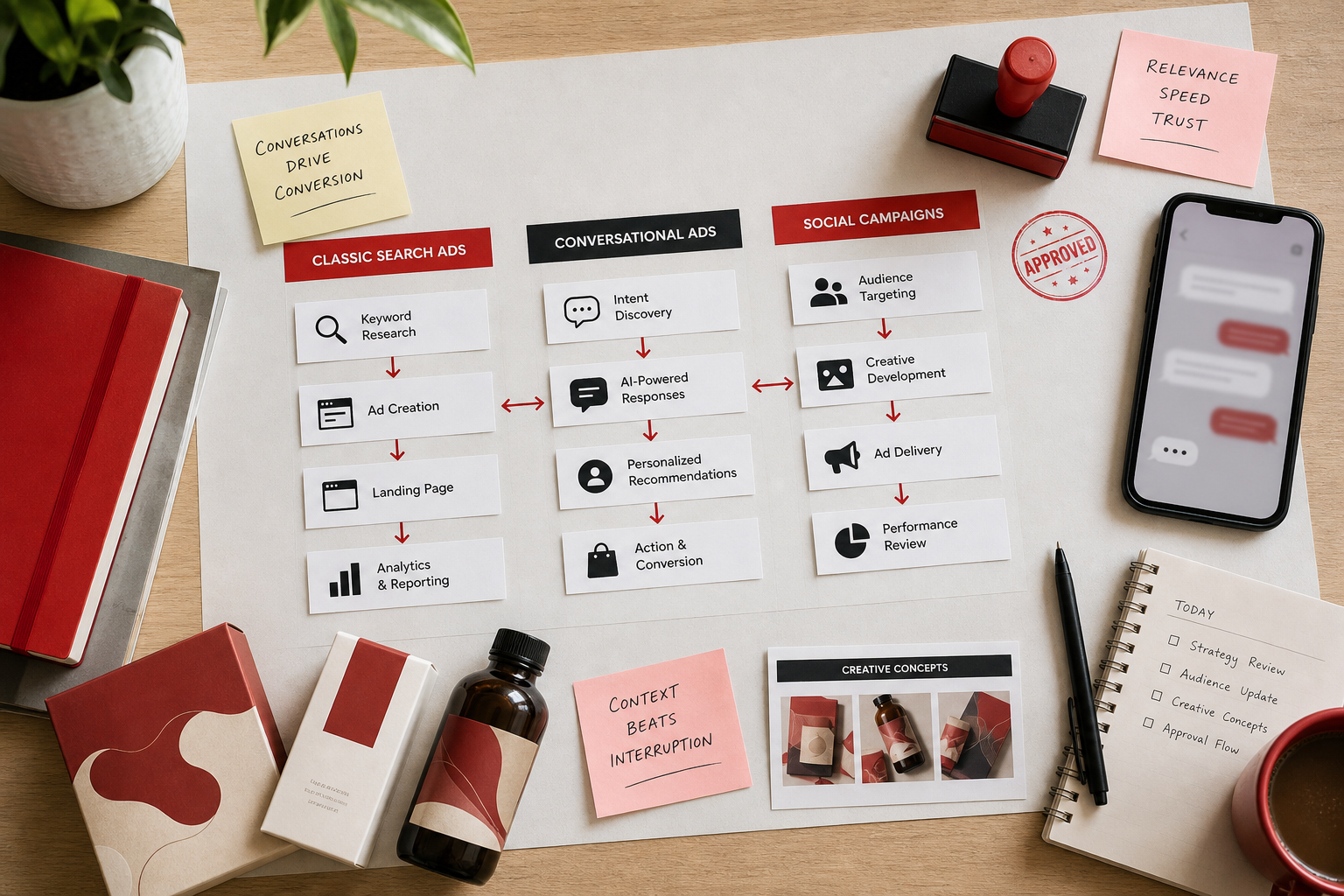
For Indian D2C and SaaS teams, this matters in a practical way. Many brands still run creative work across agencies, internal teams, catalog owners, and founders.
That setup breaks down in a channel where relevance depends on prompt context and brand-safe adaptation. If the team cannot define approved value propositions, product proof points, and disallowed claims, conversational ads will create confusion faster than demand.
There is another issue. A conversational channel exposes weak product data and weak answers very fast.
If a brand cannot explain sizing, fit, shipping, returns, or service scope clearly, the ad will not carry the whole load. That is why ChatGPT ads integration should sit next to offer design, landing-page clarity, and answer-engine readiness, not only inside paid media buying.
What should teams avoid in the first test cycle?
Avoid treating ChatGPT as only another placement to fill. The first checklist should not be CPM, reach, and speed alone. It should cover offer clarity, answer quality, approved claims, and landing-page fit. Teams that skip that checklist will blame the channel for an operating problem they already had.
How should teams set governance before scale?
Start with creative systems, not campaigns. Build one controlled source of truth for claims, proof points, product variants, and prohibited language.
Then define which prompt contexts matter most. A skincare brand may need different approved angles for budget shoppers, ingredient-conscious buyers, and gift purchasers. A B2B SaaS team may need separate variants for ops managers, founders, and procurement stakeholders.
Next, make measurement harder to fake. Track not only clicks, but also the quality of the landing page journey and downstream conversion behavior. If the ad copy promises a highly specific outcome and the landing page collapses into vague copy, the channel will look worse than it really is. The mismatch is operational, not algorithmic.
OG Marka clients already investing in digital transformation and AI agents should treat conversational advertising as one more governed workflow in the same system.
We recommend a simple framework: approved claims, approved assets, approved prompts, and approved landing pages. The winning stack is a cleaner asset pipeline, stronger product data, sharper prompt logic, and better answer-first landing pages.
What should the next 30 days look like?
- Audit your top five offers and write one approved promise, one proof point, and one prohibited claim for each offer.
- Build a small library of approved images, product angles, and audience-specific value propositions that can be reused across conversational contexts.
- Review landing pages to make sure the first screen answers the exact problem a conversational buyer would bring into ChatGPT.
- Define a measurement sheet that tracks click quality, assisted conversions, and post-click engagement before you test scale.
The correct next move is not to overreact. ChatGPT ads are still rolling out carefully. But the workflow signal is now clear. Teams that treat this as only a media-buying change will be late. Teams that treat it as a governed content-and-conversion system will be ready when the channel becomes commercially relevant in more markets.