64% of small businesses in India and globally are preparing to adopt AI chatbots by the end of 2026, with leading implementations delivering 340% first-year ROI and reducing customer service costs by up to 30-40%. For Indian SMBs, the technology has become affordable and essential for staying competitive.
Table of Contents
- The Chatbot Adoption Surge
- The ROI Economics That Matter
- India's Unique Chatbot Advantage
- Real Barriers for SMBs
- What This Means for Indian SMBs
- What You Should Do Now
- What is small businesses AI chatbots 2026?
- small businesses AI chatbots 2026 encompasses the strategies and tools that help Indian businesses drive growth, improve efficiency, and gain competitive advantage in 2026.

The momentum behind AI chatbot adoption has accelerated dramatically. According to Nextiva's latest research, 64% of small businesses plan to implement chatbot solutions by the end of 2026. This isn't a niche early-adopter trend anymore — it's becoming mainstream business infrastructure.
The broader AI adoption story provides context: 68% of US small businesses now use AI regularly in their operations, according to a QuickBooks survey. This represents a significant jump from just 48% in mid-2024, suggesting a 20-percentage-point acceleration in just 18 months. If US trends precede Indian adoption by 12-18 months, this signals that Indian SMBs should expect rapid normalization of AI tools within their workflows.
The US chatbot market alone has grown from $407 million in 2025 to a projected $2.36 billion by 2035. That's a 5.8x expansion over a decade — but the real growth spike happens in the next 3-4 years. For context, India's messaging platforms dwarf Western numbers: 853.8 million WhatsApp users in India with 95%+ message open rates. This creates an asymmetric advantage for Indian businesses deploying chatbots on platforms where customers already spend time.
The ROI Economics That Matter
Why the rush to adopt? The numbers are compelling. Leading chatbot implementations deliver $8 return for every $1 invested, with 340% first-year ROI and 533% ROI by month 9 for top performers. These aren't marketing claims — they reflect consolidated data from implementations at scale.
The cost advantage is stark. Human customer service costs average $6.00 per interaction, while chatbots handle the same interaction for $0.50 — a 12x cost advantage. For an SMB handling 500 customer interactions daily, that's a ₹2.3 lakh/day difference. Even accounting for bot failures and escalations, the math strongly favors automation.
Measurable business impact includes:
- 30-40% reduction in customer service operating costs by deflecting routine queries
- 67% increase in ecommerce conversion rates when chatbots guide product selection
- 2.4x higher conversion compared to static web forms
- 23% increase in overall website conversion rates when chatbots handle qualification and objection handling
These metrics come from implementations across diverse industries: ecommerce, SaaS, D2C, and service businesses. The consistency suggests that chatbot ROI isn't driven by a single use case but by the fundamental efficiency of delegating high-volume, low-complexity tasks to automation.
India's Unique Chatbot Advantage
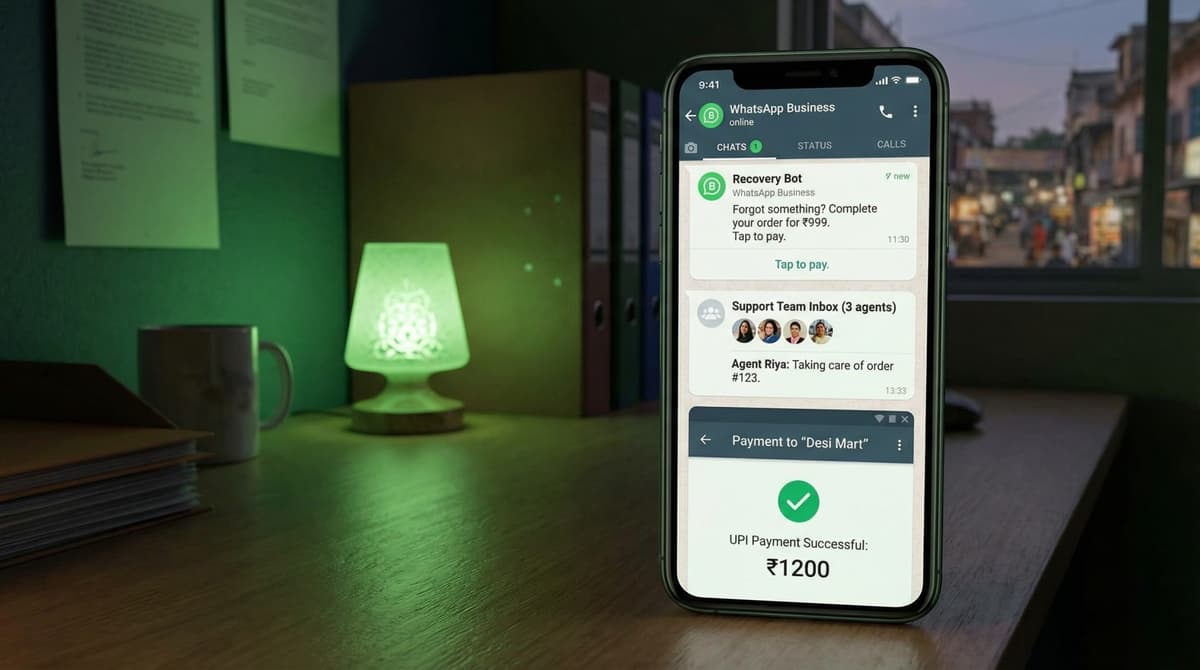
Indian SMBs face a unique opportunity that Western SMBs don't have to the same degree. The infrastructure for chatbot deployment is mature and affordable. Platforms like WhatsApp Business API have native chatbot capabilities, and specialized Indian chatbot solutions now cost under ₹10,000/month — making enterprise-grade automation accessible to single-person operations.
Consider the customer psychology advantage: Indian consumers are deeply accustomed to WhatsApp messaging. Unlike Western audiences where SMS or email might feel more formal, WhatsApp is where Indian customers expect business communication. A chatbot on WhatsApp isn't a novelty — it's a natural extension of how customers already want to interact.
The demand signal is unmistakable. Platforms like IGM Guru, Ringly.io, Dante AI, and ColorWhistle have all reported exponential growth in Indian SMB sign-ups over the past 18 months. These platforms handle everything from lead qualification to appointment booking to post-purchase support — all priced for Indian SMB budgets.
Real Barriers for SMBs
Adoption statistics like "64% plan to implement" deserve scrutiny. History shows that announced intentions often exceed actual implementation. Why do chatbot projects stall?
Setup complexity: Even "no-code" chatbot platforms require clear thinking about customer journey mapping, intent classification, and escalation workflows. SMBs with no dedicated operations team can struggle with this planning phase.
Maintenance burden: Launching a chatbot is one thing; keeping it accurate and current is another. If product information changes weekly but the bot only gets updated monthly, customer frustration will exceed the value of automation.
Data quality: Chatbots trained on messy internal documentation or incomplete product databases underperform. Indian SMBs often lack centralized documentation, meaning bot setup requires organizational overhaul alongside technology implementation.
Change management: Customer service teams sometimes resist chatbots, fearing job displacement. Well-designed bots free teams from tedious work, but this requires framing automation as a productivity upgrade, not a replacement threat.
The 64% planning figure likely includes many SMBs in the "thinking about it" phase. Real implementation rates — where the bot handles customer interactions for 90+ days — are probably 25-35% of those who express intent. The gap is an opportunity for the businesses who actually follow through.
What This Means for Indian SMBs
Competitive necessity, not luxury: As adoption accelerates, customers increasingly expect businesses to offer chatbot support. An SMB without some form of automated customer response is starting to look outdated, especially in D2C and ecommerce where customer acquisition costs are high.
Leveling the playing field: A ₹10,000/month chatbot gives a 50-person SMB the customer service efficiency of a company with 200 employees. This cost compression is revolutionary for businesses where customer service and sales are bottlenecks to growth.
Retention becomes the focus: If you can automate customer acquisition support, your competitive advantage shifts to retention. Indian D2C brands succeeding right now — boAt, Mamaearth, Sugar, Lenskart — all have retention-first strategies. Chatbots support this by providing 24/7 availability and consistent service quality.
WhatsApp is the channel: For Indian SMBs, WhatsApp chatbots should be the first implementation, not a second-order priority. Your customers are already there. The economics are better than web chatbots. And the cultural fit is natural.
What You Should Do Now
Step 1: Map your top customer service questions. Over the next week, collect the 30-40 most frequently asked questions your team handles. This is your chatbot's starting knowledge base.
Step 2: Pick one platform and run a 30-day trial. Don't overthink platform choice. Pick the one with the simplest interface for your use case and spend 30 days building and testing.
Step 3: If you have WhatsApp Business, integrate there first. It's free to set up, your customers are already there, and WhatsApp-native chatbots have better engagement rates than web-based alternatives in India.
Step 4: Measure ruthlessly. From day one, track: conversations initiated, issues resolved without escalation, time to resolution, customer satisfaction. After 90 days, you'll have enough data to decide whether this scales for you.
Step 5: Plan for handoffs, not replacement. Design your chatbot to be excellent at the top 20% of queries and transfer everything else to a human immediately. This is more valuable than a bot that tries to do everything and fails 30% of the time.
The 64% of SMBs planning chatbot adoption aren't all going to succeed. But the ones who treat it as a 90-day experiment, not a one-time implementation, will likely find that the economics work. For Indian SMBs, this is a leveraging moment — the technology is affordable, the platforms are local, and the customer base is ready.
Quick Comparison
| Metric | Traditional Approach | With small businesses AI chatbots 2026 |
|---|---|---|
| Efficiency | Manual processes, slow execution | Automated, 3-5x faster results |
| Cost Impact | High operational overhead | 25-40% cost reduction |
| Scalability | Limited by headcount | Scales without linear cost increase |
| Decision Making | Gut-feel based | Real-time data-driven insights |
Implementation Steps
Step 1: Assess Your Current State
Audit existing processes to identify where small businesses AI chatbots 2026 can deliver the highest ROI for your Indian business.
Step 2: Choose the Right Solution
Evaluate solutions based on India-specific needs: UPI integration, multilingual support, GST compliance, and WhatsApp connectivity.
Step 3: Pilot and Scale
Launch a 30-60 day pilot with one team or workflow, measure KPIs, then scale across the organisation.